Thunderstorms in New England can occur in any month, but are most common in the spring and summer. While the strength and ice content of a thunderstorm can influence the overall amount of lightning, people often don’t realize that the sound from a thunderstorm can also fluctuate based on atmospheric conditions. For one, the temperature of the air will cause sound waves to move faster or slower. For example, sound waves move with greater velocity through warm air than cold air. To examine the thermal profile of the atmosphere at all layers, meter

To examine the thermal profile of the atmosphere at all layers, meteorologists often use what is known as a sounding. This will give us the temperature and moisture content of a column of air at different height levels. I barrowed this graphic from @nymetrowx, and it does a great job calling out exactly why the thunder heard last week across CT was so loud.
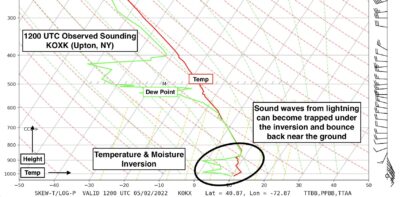
On Wednesday night, we have a what is called an inversion meaning the surface is colder than a few thousand feet overhead. On top of that layer, we have very cold air aloft helping to create instability. In this setup, thunderstorms that form are known as “elevated thunderstorms.” Elevated thunderstorms can sound louder and longer than a more typical surface based thunderstorm. The layer warmer air (inversion) acts like a ceiling, trapping the sound of thunder and refracting it back towards the ground. This refraction can amplify the sound and make it linger. The thunder can also reverberate off the inversion and echo for miles away from the storm. This is why so many people across CT felt their house shaking Wednesday night, even if they were relatively far from the CTG (cloud to ground) strike itself. Here is one last graphic showing the process.