The sun has erupted once again!
This time, a relatively simple (not complex) region produced an explosion of plasma with an M1.8 moderate intensity solar flare. The eruptions the other day were produced by a complex active region of sunspots, with three large solar flares, reaching M9.3, M7.8, and X1.1 on the solar flare x-ray scale. Again, M is the second greatest level, and X is the greatest level.
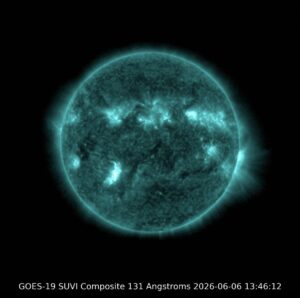
M1.8 Solar Flare viewed from GOES-19 SUVI
This eruption has once again produced an expulsion of solar material and particles in a Coronal Mass Ejections (CME). And this time, it appears the material is denser, more defined, and directed our way! The SWPC has issued a G3 level geomagnetic storm watch for today and a G2 level watch for tomorrow in preparation of the event!
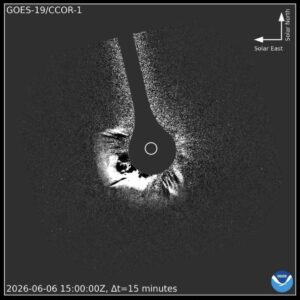
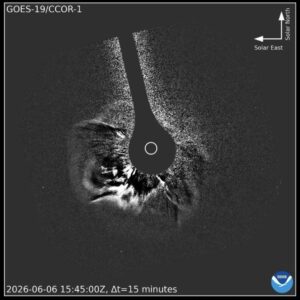
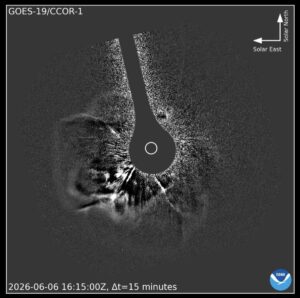
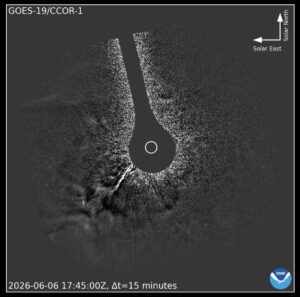
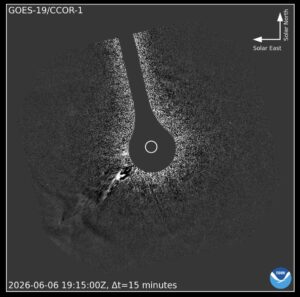
A sequence of GOES CCOR-1 DIFF Coronagraphs of the CME from immediately after launch to several hours after launching off the solar surface.
Here is a coronagraph for this cme. Notice how it’s lopsided? That because the eruption came from an area on the left (east) and slightly south part of the sun? That means while the sunspot region is well within the Earth-facing disk, the sunspot is not directly facing towards us. You can see how the densest portion of the material is launched southward and eastward on the coronagraph here. However, the important part is that the material clearly explodes outwards in all directions. That means that no matter what, a good chunk of material is headed directly at Earth! How much will arrive? We won’t be able to know until it’s here, but I would actually lean towards a more powerful storm than the other day, since the coronagraphs the other day were quite faint compared to this.
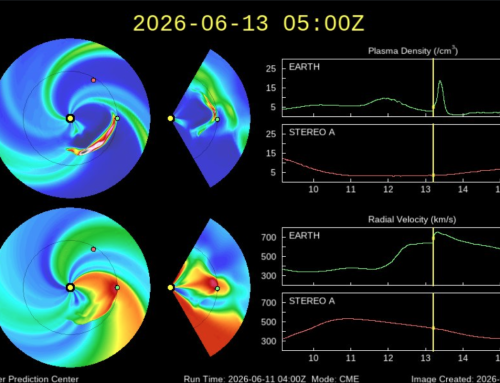
Modeling is now in for the eruption, and we have varying results with the two major models in so far, from a direct hit at Earth to a glancing blow. The impact timing is also very much uncertain.
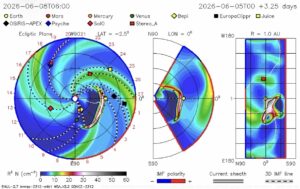
Screenshot
NASA modeling of the arrival of the CME leading edge at 6 UTC (2 AM EST) June 8.
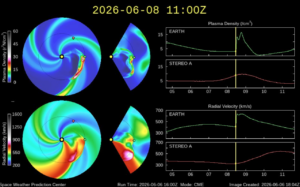
NOAA modeling of the arrival of the CME leading edge at 11 UTC (7 AM EST) June 8.
Unfortunately, most modeling suggests an arrival sometime early tomorrow morning. This could time well for us if it hits early, or we could totally miss. We’ll have to hope it arrives on the early side of our modeling. If it does and the impact is strong, we should have Aurora!
It will become dark enough to photograph Aurora around 9:40 pm once again, and the cloud cover forecast is looking pretty good once again. There is a chance we are still dealing with some low clouds until 9 or 10, but it shouldn’t interfere much during the potential Aurora viewing window!
Once again, we won’t know how strong the geomagnetic storms are until they are underway, and as a result, the strength of the aurora can’t yet be predicted either.
I suggest watching webcams to track the aurora in real time! Unfortunately, the cameras were clouded out the other day, so I was unable to track its location. Aurora visibility ended up reaching into Massachusetts the day after we were hoping for a show with the last event, as the storm lingered on for some time and the influences of a coronal hole high-speed stream arrived. The same potential for lingering shows exists here as well, and the SWPC has issued a G2 watch for tomorrow for that lingering geomagnetic storming potential, especially amplified if we do end up with a later storm arrival. Here is my favorite camera, from Mt Katahdin, Maine: https://www.youtube.com/live/lzHbycN2CmY?si=esmSe3Q1Pq50Z598
If you want to learn more about everything Aurora, check out my guide.