This (unofficial) statistic may surprise you: We have Aurora 5-10+ times a year. That doesn’t include the 2-3+ times it’s there and blocked by clouds. At the end of last summer, I became a serious aurora chaser. Since the beginning of last September, I’ve captured 12 auroras. That includes
- 9 auroras with visible structure on camera (pillars, rays, arcs, etc.)
- 2 auroras that were visible to the naked eye
I personally photograph from Westchester County, New York. Considering how far south and how close to the light pollution of New York City I am, I’m proud of how successful my statistics appear. However, that doesn’t account for the embarrassing amount of time I’ve spent trying to track these auroras. As a golfer, I can say that even golf does not approach the levels of frustration that come from aurora chasing. I’ll get into this more at the end of this guide.
The Kp Scale (G-scale)
The main measure that we use to categorize geomagnetic storming is the Kp scale.
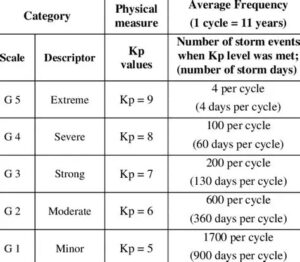
The Kp/G Scale for geomagnetic storming.
The scale runs from 0-9, and the higher the number, the stronger the overall geomagnetic storming over the latest three-hour period. These values are calculated eight times each day, and are taken from an average of K-indices from a network of 13 ground-based magnetic observatories worldwide.
I can already guess your first question: What level on the Kp scale do we need to see Aurora in Connecticut? My answer may surprise you: At a minimum, we could potentially see auroras at only Kp 5 (G1), due to substorms. I’ll get into those later on. For Kp 6 (G2), as long as it’s clear, we should have very diffuse aurora low on the horizon at the minimum, and often there will be pillars during substorms. I would guarantee tall pillars during Kp 7 (G3) conditions, and there’s also a pretty good chance that the aurora will be naked-eye visible. For Kp 8 and above, I would expect aurora to be visible on camera all night, be very high in the sky, and have short to extended periods of naked eye visibility, potentially lasting all night depending on the strength of the storm.
This scale is great to use when considering setting out on an aurora chase. But it’s only one of the key tools you need to have at your disposal when chasing aurora. When you throw all the factors together that impact your viewing of the aurora, you’ll realize that while you are likely to catch every G4 storm, you’ll miss some G3s, and you may capture a higher number of the more common G1-G2s.
Bt & Bz (IMF – Interplanetary Magnetic Field)
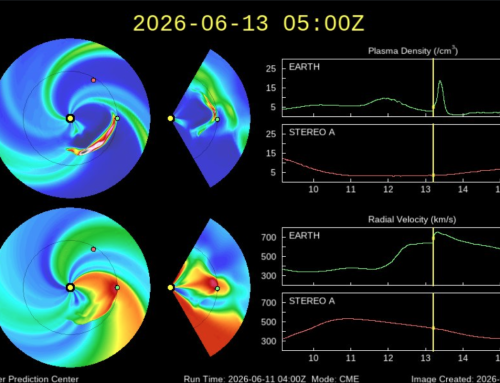
All of the magnetic disturbances that cause geomagnetic storms come as ripples in a constant flow of particles from the sun that interact with Earth’s magnetic field, known as the solar wind. The main aspect of the solar wind that drives geomagnetic storming on Earth is the Bt and Bz, which are related to the strength of the magnetic field carried in the solar wind.
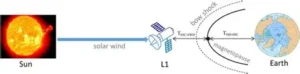
The positioning of our space weather satellites at the L1 point.
Solar wind is constantly being measured by our space weather satellites, which are positioned at the L1 Lagrange point between the Sun and Earth, about 1 million miles away from Earth. This typically gives us 30-70 minutes of warning for how powerful the solar wind is inbound. The number 1 thing aurora chasers will do in the day leading up to a potential chase night is watch the solar wind measurements from these satellites, primarily watching the Bt and Bz. The Bt is the total strength of the magnetic field detected at the satellite, and the Bz is the component of the total Bt that is aligned favorably to couple with Earth’s magnetic field and cause geomagnetic storming.
The single most important thing to have for Aurora is sustained negative (southward) Bz. In the negative direction, energy builds up in Earth’s magnetic field, which is ultimately released when particles are excited in the upper atmosphere, leading to auroras. Conversely, positive (northward) Bz is bad for Aurora, and works against it by preventing the solar wind from coupling with our magnetic field. The more negative (larger negative values) the Bz is, the better for auroras. So what chasers will do is periodically check in on solar wind data throughout the day, monitoring for long periods of -Bz. These periods of -Bz, even during the daytime, will cause energy to build up in the magnetosphere, improving your chances of seeing aurora that night. The Bz becomes even more important when it gets dark. If it stays strongly southward, you can stay out. If it’s flipping constantly or stuck northward, energy can’t build up, so you can call it a night if you don’t want to risk losing sleep on the unknown possibility it flips southward later at night.
Substorms
Once it becomes dark, there should be one aspect you should always have your eye on alongside the Bz: Substorms. Aurora is always moving, changing in shape, structure, location, and brightness. In bursts that last anywhere from 30+ minutes to under 5 minutes, the aurora often grows several times brighter, taller, and more colorful than it would otherwise appear during the rest of the night, in events known as substorms. These events push visibility of the aurora southward by hundreds of miles or more for just a short bit of time. Almost always, the best shots or videos you’ll capture of the aurora come during substorms. Unfortunately, we don’t have great ways of predicting substorms’ strength or when they might pop, so you’ll need to be extremely patient at your Aurora capturing spot if some solid -Bz has brought you out. Missing one quick substorm can easily be the difference of missing out completely on Aurora and coming away with a great shot.
So, how do you watch for substorms? There are two main ways. The first is webcams. Webcams are extremely useful for substorms, and can serve as a general measure for a night’s aurora prospects as well. If you watch the same cameras often, track where the aurora is on the camera when you see it at your location. If the aurora is nowhere close to there and it’s getting late, you can be confident any substorms that occur aren’t likely to push visibility down to you. On the other hand, if the aurora is at all somewhat close to where it is when you can see it, definitely stay out as a substorm can push visibility down to your location. The easiest way to know if a substorm is happening is by seeing it on the cameras. The second you see big pillars shoot up on camera, it’s time to take your shots!
Here are the two cameras I use most frequently!
-Mt Katahdin/Sebec Lake Maine Camera
–Cresswell/Northumberland UK Camera – this camera provides a great heads up about the activity before it’s dark enough to track over North America! (Camera is a lot less useful from May-July due to short nights around the summer solstice)
The second way aurora chasers often monitor substorms is by using a measure of magnetospheric energy buildup known as the GOES Magnetometer. If your favorite cameras are clouded out, or you’d just like another way to track substorms, watch for large, gradual drops on the GOES Magnetometer. The further down the line drops, the more energy is built up. Watch carefully for this line to spike dramatically upwards. This represents a giant release of energy and the initiation of a substorm. There’s a tiny bit of delay on this instrument compared to the webcams, so I definitely rely on cameras the most. Actually seeing what the aurora is doing is the easiest way to monitor the situation.
In certain cases, I’ve caught great aurora in G2 storms thanks to one giant auroral substorm. Significant substorms sometimes only happen once or twice a night, even during a moderate geomagnetic storm, so whatever you do, don’t miss it!
Photographing Aurora on an iPhone
The iPhone is extremely capable at photographing Aurora. The key is using the night mode feature, which looks like a little moon icon.

Night Mode on iPhone
What this does is take a special kind of photo known as a long exposure. This means that the photo is being taken over several seconds, up to 30 seconds if you can place your phone on a still tripod (highly recommended) in order to expose it for longer, and more easily capture dark night sky objects like stars and auroras.
The Changing Struggles – The Moon and Clouds
Unfortunately, weak IMF or north (+) Bz is far from the only thing that can hurt you as a chaser. I think clouds are a pretty obvious Aurora photographing issue. Cloud cover is notoriously difficult to predict, even for me as an aspiring meteorologist. It’s hard to know for sure a gap won’t open in the clouds at some point even when the forecast is cloudy, but the odds of timing a rare cloud gap with a rare substorm, it quickly gets very daunting…. The lesser-known difficulty that is much easier to predict than cloud cover is moonlight. I think a solid rule of thumb is if it’s dark enough out that you need a flashlight, you have a shot at capturing aurora. Otherwise, during the full and gibbous stages of the lunar cycle, the moonlight will unfortunately drown out the auroras in the night sky. The rare exception to this is extremely strong (G3+) auroras. Conversely, the crescent and new moon stages are great times for aurora photography, and the only light you’ll need to deal with is manmade light pollution.
The Constant Struggles – Light Pollution and Geomagnetic Latitude
Light pollution stinks! What I’ve found is that light pollution is unlikely to completely block your view of Aurora, but it will reduce the visible structure and vividness of the colors, depending on how bad it is.
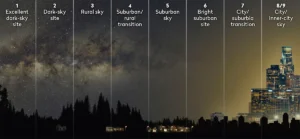
An illustration of different conditions under the Bortle Scale and where they may typically be found.
The Bortle scale runs from 0 to 9 (coincidentally just like the Kp scale!) representing the amount of light pollution in your sky. It can also show you what kind of light pollution you have to look over/through when pointing your camera north for auroras. Cities will always produce big time light pollution, and towns will produce a bit as well. I have personally captured all of my auroras under my Bortle 5.9 skies, and I’d say I’ve had a fair amount of success.

A Bortle Scale light pollution map. Closer to red = worse light pollution, closer to blue/green = better/less light pollution.
Of course, if I were situated in darker skies or wanted to make the long trek north, I could have come away with better shots for sure. If you are ever driving for Aurora, it should be entirely to get away from light pollution, not trying to go further north, as you won’t end up with very different results at all being 50-100 miles north if you still have similar light pollution in your way.
The other constant difficulty we have is our distance from the typical auroral oval (location of the Aurora). The Magnetic North Pole doesn’t align perfectly with Earth’s North Pole, and it actually differs by quite a bit. The typical latitude measure is not super useful as a result, so we go by geomagnetic latitude, or your latitude relative to the Magnetic North Pole.
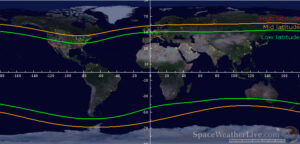
A world map of geomagnetic latitude, split up into High Latitude, Mid Latitude, and Low Latitude.
We are in the “mid latitudes”, which actually lines us up pretty evenly with the UK (a great reason to utilize their aurora cameras!!!!). Unless you book a plane trip northward, your geomagnetic latitude is not something you can deal with by traveling. Driving north when Aurora is out will NOT help you, if it does, it’s just because you escaped the light pollution!! Luckily, we are at a very high geomagnetic latitude with respect to our latitude. The lowest the geomagnetic latitudes dip towards the typical latitudes is over the central US!
My Final Notes for Potential Chasers
Aurora will sometimes be kind: mainstream news will cover it, it will be out right after sunset, and you can go to bed at a decent hour after capturing some nice Aurora. But more often, Aurora will be unkind. You may only know there’s a chance for Aurora that night by checking solar wind conditions yourself. Most of the time, it won’t be out right after sunset.
Twice, I captured the best (and only) Aurora of the night between 2 and 4am. It’s that constant possibility that Aurora might come out that stops me from going to sleep, too scared of missing out on a late show. It happened to me once and it was traumatizing. What’s even worse is a night with a strong Aurora being captured from New Mexico, but with clouds preventing it being seen from here.
Another awful scenario that happens often is the Aurora peaking before North American darkness. Aurora will be reported on camera at geomagnetic latitudes well south of here in Europe, but will decay by the time it’s dark here. Oftentimes, the moon is just casting too much moonlight for the Aurora to be seen, even if it’s there.
If I didn’t get my point across, there’s a TON of ways for things to go wrong. I’ve learned that the best attitude to have is high hopes, low expectations. If you plan on chasing, good luck!