The sun has erupted in a massive way over the last 48 hours!
A complex active region of sunspots on the sun has erupted in a series of three large solar flares, reaching M9.3, M7.8, and X1.1 on the solar flare x-ray scale. M is the second greatest level, and X is the greatest level.
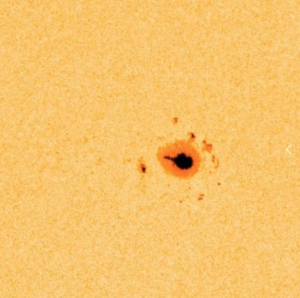
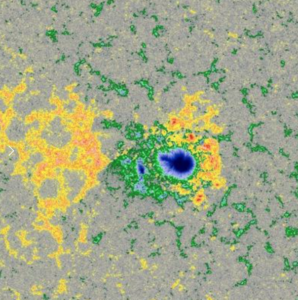
Sunspot region 4455, as seen through traditional and magnetogram imagery, which is highly active, complex, and responsible for all of the major flares.
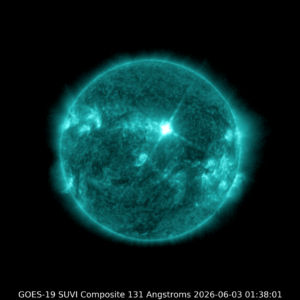
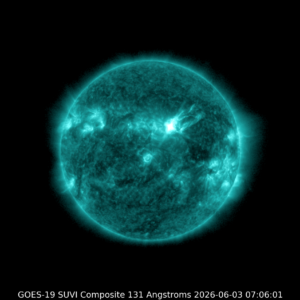
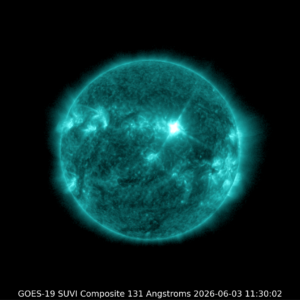
The M9.3, M7.8, and X1.1 solar flares as photographed by the GOES-19 Satellite’s SUVI instrument.
These eruptions have each produced expulsions of solar material and particles known as Coronal Mass Ejections (CMEs). And the great news is, these are largely directed towards the Earth!!!! Modeling is now in for the three eruptions, and most indicate a direct hit at Earth!
For now, the composite CME models have yet to include the third (X1.1) CME, but it appears to be a glancing to slightly direct hit and traveling right behind the first two blasts.
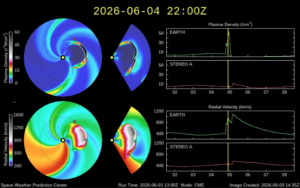
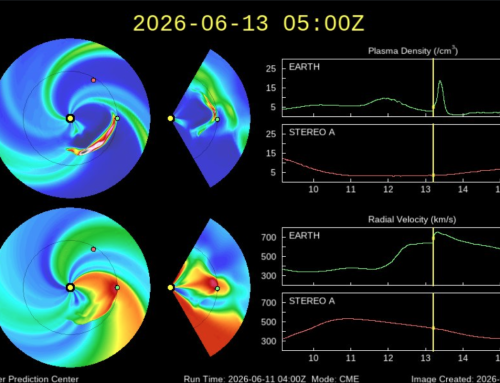
The Space Weather Prediction Center’s WSA-Enlil CME model. The top portion is plasma density, and the bottom portion is solar wind velocity. The left chart is a view looking down from above the Sun’s North Pole, the central chart is a side view looking from within Earth’s orbital plane, and the right chart is a graph which times the density and the speed of the solar wind experienced at Earth. The Earth is the green dot to the right.
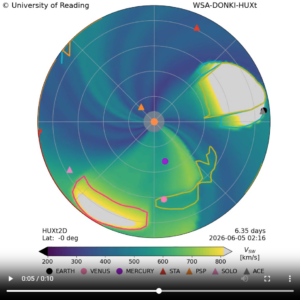
The University of Reading’s HUXt model. This is a view looking down from above the Sun’s North Pole, the Earth is the black dot to the right.
Since the later CMEs appear to be traveling faster, and due to the fact that the first cme clears out the solar wind and allows the later CMEs to travel faster, it is likely that the later CMEs will catch up to the first one or impact very shortly behind, creating a combined impact of three CMEs! This could make for an extremely powerful geomagnetic disturbance depending on the strength and configuration of the magnetic fields contained in the CMEs.
Most modeling suggests an arrival sometime tonight (June 4). This should time extremely well for us!
It will become dark enough to photograph Aurora around 9:40 pm tonight, and the cloud cover forecast is looking pretty good. There is a small bit of uncertainty, but it should be mainly clear with potentially a few high clouds.
We won’t know how strong the geomagnetic storms are until they are underway, and as a result, the strength of the aurora can’t yet be predicted either. What we do know is that a shockwave is almost certain to arrive. Powerful CME shockwaves act like snowplows, plowing the solar wind that lies in front of it. This compresses the solar wind and catches a large number of low-energy protons that lie in the ambient solar wind.
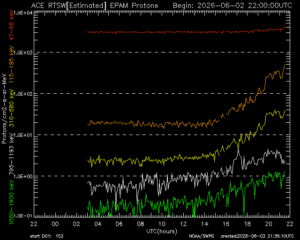
The ACE Satellite EPAM Proton Monitor showing a steep rise in low energy protons in several energy thresholds over the previous 24 hours.
We are already seeing a tremendous rise in the low-energy proton counts at Earth, which is a great sign that something big is headed our way…..
I suggest watching webcams to track the aurora in real time!
Here is my favorite camera, from Mt Katahdin, Maine: https://www.youtube.com/live/lzHbycN2CmY?si=4QzDtMpfJHIaWeDI
If you want to learn more about everything Aurora, check out my guide!